Eric Lang (with Pat Harrigan) explains the advantages writers have in crafting adaptations of literary franchises into collectible card games. Lang maintains that, while attempting to remain true to the original, when turning narratives into games, one must "respect the medium."
There are a fair number of games in the hobby industry based on literary licenses. I've played most of them, and designed a certain number myself. For almost every license, there is a divergent theory about just how a design can capture the essence of the literary property while maintaining its integrity as a game.
The first collectible card game (CCG) I designed was based on Roger Zelazny's Chronicles of Amber novels, but unfortunately that design never made it to publication. My first published designs were the A Game of Thrones CCG and the Call of Cthulhu CCG, both by Fantasy Flight Games (FFG). A Game of Thrones is based on George R. R. Martin's Song of Ice and Fire series of fantasy novels, and Call of Cthulhu is based on the works of H. P. Lovecraft and other Cthulhu Mythos writers.
Simulation and Evocation
I should note here that the theoretical positions in this essay are written from the point of view of tabletop games (card, board, role-playing), although I find the principles to be fairly universal. And although there is a general consensus among designers as to the meaning of simulation in games, there are a few slightly different ideas about just what simulation actually means.
To many, simulation means using game mechanics as a set of tools to recreate a linear thread of events, one that mimics the source narrative as closely as possible. Such a design would be considered successful if it were possible for players to use the game to role-play the story (say, the entirety of The Lord of the Rings or A Song of Ice and Fire), while still being offered the option to diverge from the narrative for the sake of replayability.

It is my belief that simulation, as a means to an end, is often misused in games. Many believe that the player's motivation to immerse herself in the world informs every aspect of her play pattern. While it is true that her affinity for the literary property will most likely lead her to the game in the first place, and that a successful atmospheric evocation will enhance her experience, it rarely goes farther than this.
"Evocation," is what I have self-defined as the goal of a successful design based on a strong property. I believe that what players want is not so much to transpose themselves into the heart of the narrative through game play, but to enjoy a lateral experience that enhances their overall appreciation for the property.
One can evoke a theme or genre by taking a function-oriented design and priming the rules and components with strategically placed keywords and themes. Thus, the rules and components of a game based on The Lord of the Rings will, no doubt, make liberal use of hobbits, ringwraiths, Eyes of Saurons, etc. In fact, Reiner Knizia's excellent board game, Lord of the Rings: The Confrontation, is fundamentally such an abstract game, with a Lord of the Rings theme "spray-painted" onto it. It should be said that this in no way diminishes the quality of the game itself. A game based on A Song of Ice and Fire can be expected to involve sellswords, maesters, the Great Houses of Stark, Lannister, and Targaryen, and many other key concepts of George R. R. Martin's books.
This is one area where having a background in writing is a distinct advantage; good writers get the maximum effect from a carefully chosen minimum of words.
Loaded words in games do double duty in this case: they both harness a player's intuition to evoke the mood or atmosphere of the setting, and ease the learning curve of the game itself (stories are easier to follow than a highly technical set of rules). The choice of which (and how many) terms to use is not trivial, of course. One cannot simply pepper a game with random fantasy jargon, lest it seem contrived and burdensome.
While it is true that tension exists between the authorial dictatorship of storytelling and the decision trees of game playing, games are not without narrative flow. Like stories, games have a beginning, middle, and end. The best games have an ebb and flow of tension that escalates between "plot points" (in games, these are what I refer to as the "payoff moments" - when the tide of strategy in a game has turned in a player's favor, and the action takes a new direction) until finally arriving at a climax.
While it is important to make sure a game is fair and balanced, it is equally important to engineer the experience such that the average game will follow such a narrative flow. If players are acutely aware of a beginning, middle, and end to their game experience, this will also serve to evoke the literary source material.

Respecting the Medium
As with all licenses, it must be recognized that a game set in a particular extra-game storyworld is an adaptation of the story experience. Games form their own paradigm, obviously, but even within the realm of games there exist several unique paradigms that must be understood and respected. Trying to create, for example, a "strategic game of spatial relations" as a collectible card game (and not, for instance, a board game, for which the concept might be better suited) will often lead to a subpar result.
For example, the creators of Guardians of Order's A Game of Thrones role-playing game undertook a drastically different design process than I did with the AGOT collectible card game. This much might seem obvious, but I have too often witnessed designers take a single approach to a property regardless of medium.
Creative Practicalities
The process of creating a CCG is not a solitary one. Although I created the game structures and rules for both the A Game of Thrones and Call of Cthulhu CCGs, FFG management advised at all stages of the initial development. After the games launched, I restricted myself to designing the mechanics of the individual cards, leaving much of the creative development (writing card names, assigning art descriptions to the artists, creating "flavor text") to the FFG staff developers (mostly staff CCG developer Casey Galvan and my studio partner Jonathan Moriarty) or freelancers. Teams of playtesters were also employed to identify potential problems with card interactions that were missed during design and development. Collectible Card Games - The first collectible card game was Wizards of the Coast's Magic: The Gathering, still the most popular and profitable CCG in the world. All other CCGs inevitably descend from the Magic model. Several of the larger publishers release collectible card games in "sets" or "blocks" of new cards several times a year. FFG releases three sets each of AGOT and COC every year: one "base set," consisting of 240-odd cards, and two "expansion sets" of 140-odd cards; the three annual sets are referred to collectively as a "block." Each release consists of a certain number of new cards, some of which are more easily obtainable than others. FFG, following the model of most other hobby game companies, releases each new set in the form of packs of cards; each pack contains eleven cards randomly drawn from the new set, seven of which are "common" cards, three of which are "uncommon," and one of which is "rare." Consequently it is more difficult to collect the uncommon cards than the commons, and significantly more difficult to collect the rares. Although it is practically and financially infeasible for most players to collect every card from a particular release, it is fortunately not necessary to try. Players are expected to construct playable "decks" of cards (usually of about 50-60 cards) from the pool of cards available to them; their opponents do the same. Players then square off, seeing who can construct the better deck and, once constructed, utilize it better. What sets CCGs apart from other forms of hobby games is the on-the-fly customizability of each player's deck. While a typical board or card game (e.g., Clue, poker) utilizes a single unvarying set of game components (board and pieces, deck of fifty-two cards, etc.), players of a CCG have hundreds or thousands of cards to select from when constructing their decks. If a player is being routinely beaten by an opponent, she may revise or reconstruct her deck, using different cards from the available sets, in order to beat her opponent the next time she plays. That opponent may then find herself in the same position, and need to reconstruct her own deck - and so on ad infinitum.

A Game of Thrones CCG
To my advantage, I had already read most of the Song of Ice and Fire series before being asked to lead the design of the collectible card game. I could have designed a game that simulated the events of the War of Five Kings effortlessly, but this was not the goal. Before the design period began, FFG had identified its target market: fantasy readers and collectible card game "fad players" (i.e., the pool of gamers in the hobby industry who drift from hot new game to hot new game - whose loyalty is invaluable but difficult to obtain).
Most of the players for the game would be familiar with collectible card games, but would only have dabbled in them at best. It was also crucial to the success of the game that it be playable without any knowledge of the property. At the time, Martin's series was very popular but had not quite peaked. It was at what we called a "latent" stage, where it still had the opportunity to significantly grow its fan base. This was important at the beginning stage of design, because it meant I also had to take into account that approximately half of our initial audience would not yet have read the books.
One of the decisions I made in the game design that truly paid off was the use of carefully chosen "loaded" terms. For example, I selected the term "kneel" to indicate that a particular card has been temporarily used (this is a standard CCG mechanic, normally called "tap" or "turn"). This strongly evoked a medieval air, and brought to mind the many occasions in the series where characters are said to "bend the knee" to signal obedience. The names of some of the phases of the game turn (Plot, Draw, Marshalling, Challenges, Dominance, Stand) strongly implied a narrative flow; the first card a player would see when he or she began the game would be a House card with these phases written on it. Without knowing a single thing about the game, a new player would subconsciously approach the game expecting medieval conflict and intrigue. This in turn would inform the remainder of their experience.
The AGOT gameplay breaks down to this: each player represents one of the Great Houses of Westeros, and competes to be the first player to reach 15 points of power. They do this by marshalling certain characters (sometimes specific characters from the books, such as Eddard Stark or Khal Drogo, and sometimes more generic types, such as "House Umber Knight" or "Sellsword" - but even most of the generic characters are named in accordance with the conventions George R. R. Martin laid out in his series) and competing with their opponents' characters in three types of challenges: military, intrigue, and power. Different challenges provide different benefits for the winner.
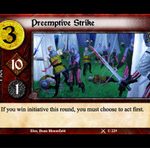
In addition to their primary deck of cards, players also have a seven-card "plot deck," one card of which each player reveals each round. The revealed plots have global effects (such as "Kill all characters in play") and identify other parameters for that round as well, such as how much gold the player will have to spend, in what order she takes her turn, etc. The plot cards were an attempt to reconstruct some of the larger trans-individual events in Martin's series, events that were not triggered solely by the actions of particular characters or Houses. On a gameplay level, they added another element of player strategy: in addition to selecting characters, locations, events, and items for their primary decks, players also had to decide which plots would most hinder their opponents and allow their own primary decks to work to their best advantage.
Even beyond the combinatorial aspects of the other cards, the plot cards added more potential variation to game events. In my early years as a designer I had learned a powerful lesson: part of what people enjoy about licensed properties is the ability to break the author's rules and create situations that break canon. Many designers might shy away from "ridiculous" situations within the game-sphere, but I embraced the possibilities.
A helpful mantra is: Respect the medium. Collectible card games are at their root combinatorial exercises; players fall in love with possibilities as much as they do strategies, and no other type of game offers more options. As long as players could conceive of the possibility that an event might take place in the world of Westeros, I had to make sure it could be done in the game. And in many cases, things that could never happen in the books could also be done.
A Contrasting Design: Call of Cthulhu CCG

Designing FFG's follow-up to the A Game of Thrones CCG was a very different experience. The Cthulhu Mythos is a far more diffuse series of works than the three volumes of A Song of Ice and Fire that had then been published. The design mandate had limited our source material to those stories written by H. P. Lovecraft and those game materials published by Chaosium (excluding much contemporary Lovecraftian fiction and certain latter-day game properties to which we didn't have the rights, such as Pagan Publishing's Delta Green), but this was still a vast amount of material.
Complicating things even further was the nature of the Cthulhu Mythos itself. Martin's series was the creation of a single author, but the material of the Cthulhu Mythos was a patchwork of stories and game material from dozens of different authors, over the course of most of the twentieth century. Lovecraft himself wasn't interested in formalizing the background and concepts of the Cthulhu Mythos (in fact, the idea of doing so was arguably opposed to his aesthetic project), so there was no central authority to refer to as there was in the case of A Game of Thrones.
At the same time, this freed the creative team (mostly Pat Harrigan and Darrell Hardy) to get creative with the material. George R. R. Martin had created a coherent fantasy world for A Song of Ice and Fire and was understandably protective about the liberties we could take with that world. But the loose, almost improvisational, nature of the Cthulhu Mythos allowed the design team a certain amount of creative freedom.
On a design level though, this presented a problem. The Chaosium RPG - which would be the reference point for most people in our industry familiar with the Mythos - had generally cast players as intrepid investigators fighting the forces of the Mythos, and this lent itself to a two-sided "asymmetrical design." Players would either play the investigators or the unspeakable horrors of the Mythos. However, feedback from hobby games retailers had convinced FFG that a game consisting of only two non-combinable sides was not a saleable product. There had to be more than two factions, and they had to be fully combinable. Therefore, we invented seven factions (the Blackwood Detective Agency, Miskatonic University, the Syndicate, the Cthulhu Cult, the Cult of Hastur, the Cult of Yog-Sothoth, and the Cult of Shub-Niggurath), any one of which could be combined with any other. To avoid absurdities such as Professor Armitage teaming up with Cthulhu, we also introduced the keywords "Heroic" and "Villainous." A heroic character could not be in play on the same side as a villainous character, and vice versa.
The original COC design involved Investigators trying to complete "case" cards, and Mythos players trying to complete "conspiracy" cards, but this made no sense in the new seven-faction design. I collapsed the cases and conspiracies into one "story card" deck that was functionally distinct from the AGOT "plot" deck. Instead of each player bringing a customized plot deck, in COC the players would draw from a central deck of story cards, three of which would be drawn at the start of each game and placed between the players. When a story card was won, it would be replaced with the next card from the story deck.
The story deck would always consist of the same ten cards, but would be shuffled before each game so that players could not predict the order in which the cards would come up. Players would compete to place victory tokens on their side of the story. The first player to get five tokens on their side would win that story card; the first player to win three story cards would win the game.
Like AGOT's plot cards, the story cards would have global effects (e.g., "Discard all characters in play"), but these effects would only trigger if the winner of the story card wanted them to. In other words, if you won a story, you had the option of enacting its effects.
This is the inverse of AGOT's "plot" model. In Martin's A Song of Ice and Fire (still uncompleted at the time of this writing), the reader is privy to the complicated intrigues of the Great Houses, but not to their ultimate outcomes. In the heterogeneous stories of the Cthulhu Mythos, the resolution of any individual tale is often reliant on whether the forces of humanity or the abyss get the upper hand (and there are plenty of examples of both in Lovecraftian fiction and Chaosium's RPG). Therefore the resolution of AGOT's plots is only a step on the road to victory, while the successful resolution of COC stories is an end in itself - in fact, it is the very way victory is achieved.
References
Call of Cthulhu CCG. Eric Lang; Fantasy Flight Games. 2004.
A Game of Thrones CCG. Eric Lang and Christian T. Petersen; Fantasy Flight Games. 2002.
Magic: The Gathering. Richard Garfield; Wizards of the Coast. 1994.